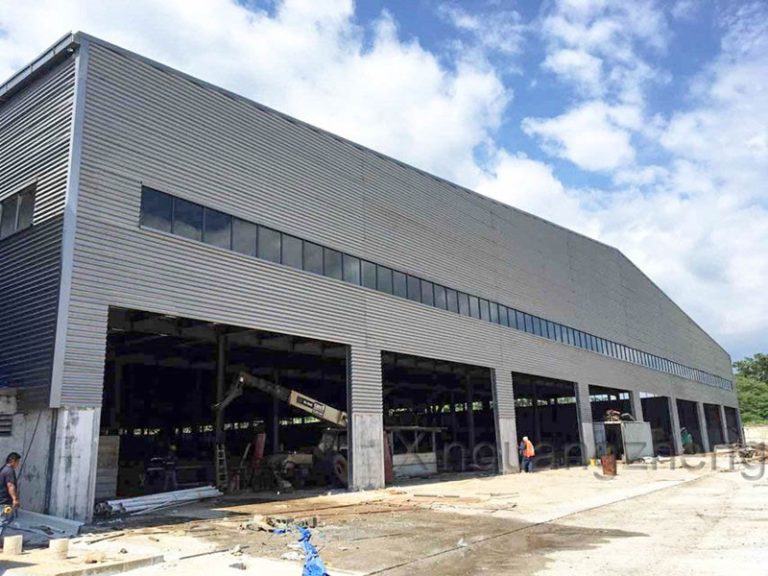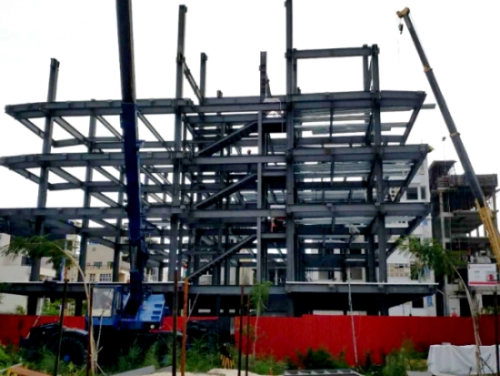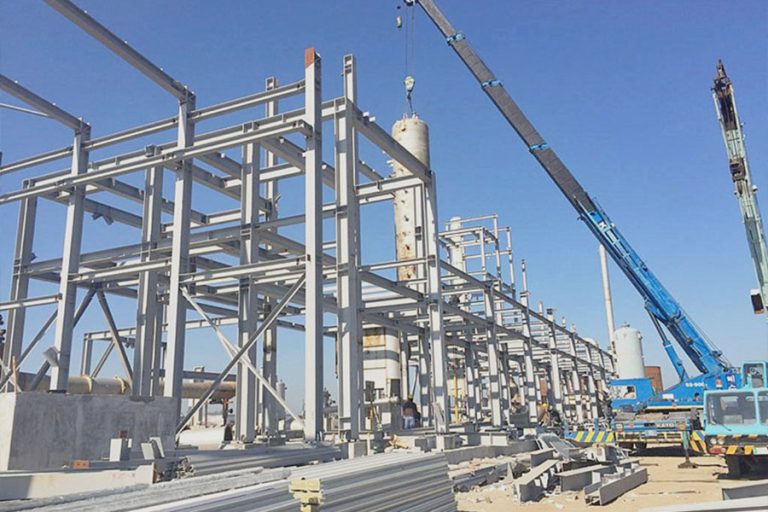
Steel portal frame construction is widely used for warehouses, factories, workshops, agricultural facilities, aircraft hangars, and other buildings that require large, open internal spaces. Instead of relying on numerous interior columns, the structural system uses rigidly connected steel columns and rafters to resist vertical and horizontal forces.
This guide outlines the basic principles of steel portal frames, including their components, production, and construction, and provides information on the key factors of any project that must be considered before commencing construction.
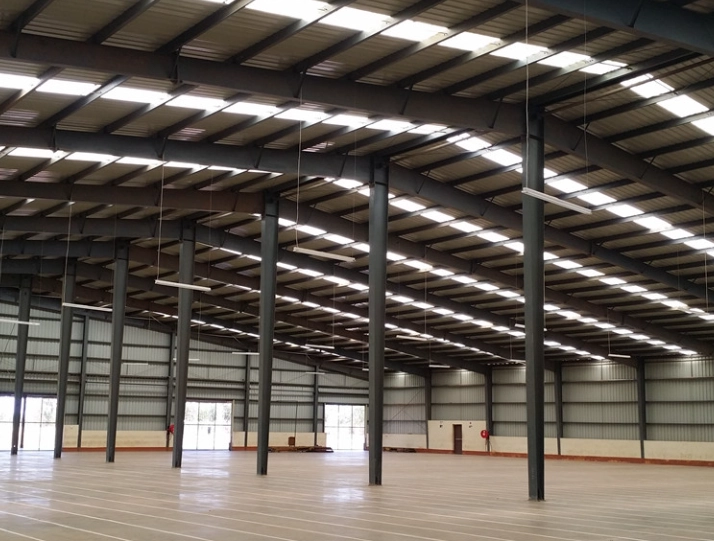
What Is Portal Frame Construction and How Does the Structural System Work?
How Do Rigid Columns, Rafters, and Haunches Transfer Loads?
A portal frame is a structural system made of vertical columns and of sloping or horizontal rafters joined together at rigid joints. The frame is capable of resisting the bending moments, as well as vertical and lateral loads.
The roof loads are first carried by the roof covering and roof panels. The loads are transferred to the purlins, then to the rafters, and thence to the columns. The loads are carried down from the columns by the base plates and anchor bolts to the foundations.
Haunches are often incorporated near the eaves, at the junction between columns and rafters. Because this area is subject to large bending stresses, a deeper section of timber is created locally to enhance the local strength and stiffness without the need for the entire rafter section to be increased in depth.
All components are connected. Therefore, a change in a design parameter has an influence on other parts of the building.
Where Are Steel Portal Frame Structures Commonly Used?
Portal frames are a very suitable structural system for low-rise buildings that need a lot of flexibility within their plan and large, clear span areas.
Common applications include:
| Warehouse | Open storage and racking space | Fewer internal columns improve space utilization |
| Factory | Production lines and equipment | The structural grid can follow the manufacturing layout |
| Workshop | Vehicle or machinery access | Wide bays allow larger doors and operational clearance |
| Agricultural building | Economical covered space | Standardized components support efficient construction |
| Aircraft hangar | Large unobstructed opening | Clear-span framing accommodates aircraft movement |
| Commercial facility | Flexible floor planning | The enclosure and façade can be adapted to the project |
What Are the Main Steel Portal Frame Components?
Primary Frame Components Including Columns, Rafters, Haunches, and Connections
The primary frame of a building is designed to carry the majority of the load of the building and consists of the following main elements:
- The columns are supporting the rafters and transferring the vertical and lateral loads to the foundations. The size of the columns is determined by the height of the building, the spacing of the beams in the building’s frame, the roof loading, the loading of any cranes, and other environmental loading on the building.
- Rafters are the main roof structural members and can be made in tapered form or in uniform form, depending on the design and manufacturing method used.
- The flared portion of a column haunches out to form a stronger section in the high-moment area at eaves and can increase overall stiffness, yet use less steel than an increased section size.
- Apex connections are usually made between rafters near the roof ridge. These connections must be designed with the bolts, plates, etc., and geometry to transfer the loads as determined for the frame.
- Eave connections join the columns and rafters. Because these rigid joints are central to portal frame behavior, accurate fabrication and installation are essential.
- The base plates with associated anchor bolts are fixed to the concrete foundations. The position of the anchor bolts must be controlled with dimensional accuracy before the steel arrives on site to avoid potential problems during the erection process.
Secondary Components Including Purlins, Girts, Bracing, Cladding, and Foundations
While secondary building components do not replace the main building frame, they play a critical role in ensuring the overall stability and performance of a building.
Purlins are used to support roof liners and transfer loads down through the roof space to the main roof rafters. Girts are similar for wall cladding.
Roof and wall bracing controls longitudinal forces in a building and helps to stabilize it during both the construction phase and normal use of the building. Temporary bracing may also be required until the main structure has been completed.
Cladding forms the external envelope of a building. It can be a single steel sheet or an insulated sandwich panel. It can also be a number of different materials combined together in a number of different ways to create a composite system. Other examples are the use of glass to form a curtain wall or a number of different materials to form the external enclosure of a building for a specific use.
In addition to transferring vertical reactions, resisting horizontal forces, and overturning moments, the design of the foundations is influenced by more than the steel frame itself: by the soil properties, groundwater level, possible action of frost, the required earthquake resistance, and local conditions of the construction industry.
What Is the Steel Portal Frame Construction Process?
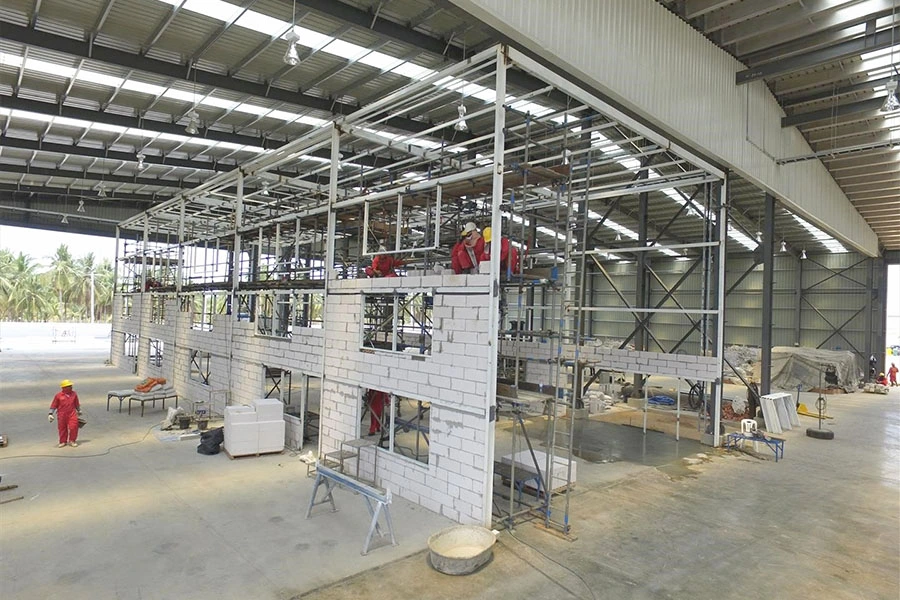
Engineering, Structural Detailing, and Factory Fabrication
The information gathering process for a project starts with collecting relevant project information. Inputs such as building dimensions, clear span, eave height, bay spacing, roof slope, door opening, crane, equipment loads, local design standards, and wind, snow, and earthquake loads, etc., are normal inputs for the information gathering process for a project.
Engineers use information supplied to create the structural framework and to calculate forces within the individual members. Information is then converted to enable the precise creation of items to be installed on site, such as detailed drawings for the fabrication of individual members. These drawings highlight the size of individual members in great detail, including connection plates, bolt positions, welds, additional localized support members, base plates that members rest upon, and other related details – with each item being clearly marked and referenced for identification purposes on site.
XINGUANGZHENG integrates design, production, installation support, and after-sales service within one workflow for a project. The design capability of XINGUANGZHENG covers architectural design, structural design, mechanical and electrical co-ordination, engineering consultant services, and BIM-related services. Therefore, it minimizes the coordination gaps between the building design and the manufactured steel parts.
Production of steel plates and sections is followed by cutting, assembly, welding, drilling, correction, inspection, and treatment. We utilize a range of production equipment, such as laser cutting of plates, intelligent cutting and marking of profiles, welding robots, H-section production lines, automated correction lines, and spraying lines.
Foundation Preparation and Portal Frame Erection Sequence
Foundation work can often proceed during steel fabrication when drawings and anchor bolt layouts are confirmed early.
A typical erection sequence includes:
- Checking foundation levels and anchor bolt positions.
- Installing the first columns.
- Lifting and connecting the first rafter assembly.
- Adding temporary bracing to stabilize the first bay.
- Installing the remaining frames.
- Connecting purlins, girts, and permanent bracing.
- Checking alignment, verticality, and bolt tightening.
- Completing the roof and wall enclosure.
The first stable bay sets the alignment for the remaining structure, so temporary supports must remain until permanent bracing is complete.
Cladding Installation, Quality Inspection, and Project Handover
After the structural frame is stable, installers can begin the roof and wall enclosure. The sequence should account for drainage, overlaps, sealants, insulation continuity, flashing, openings, and penetrations for ventilation or mechanical systems.
Quality inspection normally covers:
- Frame alignment and column verticality
- Connection bolts and weld conditions
- Bracing installation
- Roof and wall panel fastening
- Flashing and waterproofing details
- Protective coating damage
- Door, window, and equipment openings
- Drainage components
- Completion documents and component records
Damage to the coating during transport or on-site must be repaired with the relevant system. A full handover of the plant, including operating instructions for doors, ventilation, cranes, etc., where fitted, must also be given.
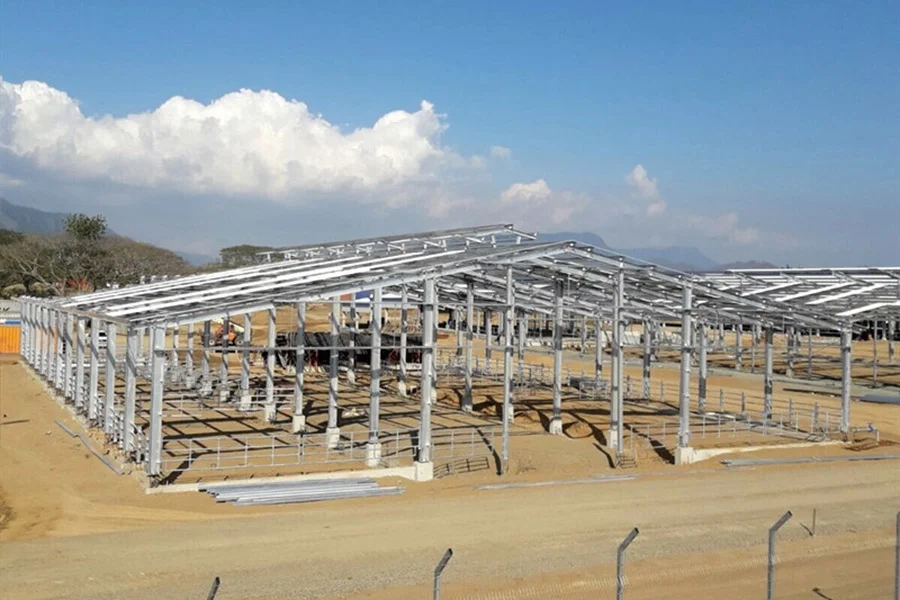
Which Design Factors Determine Portal Frame Performance?
How Do Span, Eave Height, Bay Spacing, and Crane Loads Affect the Design?
A wider span improves interior flexibility but may require deeper rafters, stronger joints, or larger foundations. Greater eave height increases usable volume but also raises wind effects and column demands.
Bay spacing affects both the number of main frames and the load carried by each frame, purlin, and girt.
Overhead cranes introduce vertical wheel loads, horizontal forces, braking loads, and repeated operation. Crane capacity, duty class, runway level, and future equipment plans must be confirmed before the frame design is finalized.
How Do Wind, Snow, Seismic Conditions, and Corrosion Affect the System?
Wind creates pressure, suction, and roof uplift. Large door openings may also change internal pressure.
Snow loads vary by region, elevation, roof geometry, and drifting conditions. Seismic requirements can change connection details, bracing arrangements, and foundations.
Corrosion protection should match the environment. A dry inland warehouse does not need the same coating system as a coastal factory, chemical plant, or humid agricultural building.
Frequently Asked Questions
Q: What is steel portal frame construction?
A: Steel portal frame construction utilises connected steel columns and rafters forming a stable steel building frame. The principal structural system transfers roof loads, wall loads, wind loads and operational loads via the main steel building frame down to the foundation.
Q: What are the main steel portal frame components?
A: Column, rafter, haunch, etc., Apex & eave connection, base plate, anchor bolt, purlin, girt, bracing, exterior cladding, foundations, etc.
Q: What is the typical steel portal frame construction process?
A: Data collection for the project, the structural design, detailed engineering for the building, fabrication of components in a factory, preparation of the foundation, the frame is erected, the bracing is installed, the external cladding is fitted out, the building is inspected, and the building is handed over.
Q: What portal frame span is suitable for a warehouse?
A: There is no universal span for every warehouse. The correct span depends on storage layout, clear-space requirements, building height, bay spacing, crane loads, local environmental loads, foundations, and the applicable design standard.
Q: What are the advantages and disadvantages of portal frame construction?
Advantages: clearly defined internal space, efficient production, fast site installation, flexible internal planning, compatible with industry processes. Disadvantages: increasing structural requirements at extreme spans, very dependent on all connections being adequately rigid, requires project-specific solutions for fire, insulation, corrosion and foundations.
Engineering Inputs to Confirm for a Steel Structure Project
Concept selection should be based on the building use, required clear span, column grid, eave height, equipment and crane loads, service openings, envelope system and local design criteria. Site wind, snow, seismic and corrosion conditions must be confirmed before structural sizing. The quotation should also distinguish engineering, fabrication, delivery, erection guidance and work assigned to the local contractor.
See our industrial steel structure applications, review steel structure design and fabrication support, explore project examples, or submit your project inputs for an initial review.